
Plant BioDesign PhD Programme: Designing Plant Systems for a Green Economy

PhD projects will tackle challenges of clean growth, resilient food and environmental sustainability by engineering plants e.g. for biomanufacturing, disease resistance, increased yields and phytoremediation, as well as developing new tools for gene editing, large-scale screening and synthetic control.

Build your skills in engineering biology for enterprise, technology, research & innovation careers.

APPLY NOW: Deadline 19 January 2026

(PhD 1) Pierre Buscail and Thomas E. Gorochowski to create SynProm, a modular synthetic biology toolkit for rapid, spatio-temporal monitoring of plant gene activity. Design, test & model synthetic promoters in Nicotiana benthamiana with a focus on plant immunity.
Apply here: https://lnkd.in/euhCHSmC

(PhD 2) Heather Whitney, Thomas E. Gorochowski, and M. Carmen Galan + more, to take plant RNA synthetic biology to a new level. Create novel biofacbrication methods that blend living and non-living processes to enable robust and effective RNA delivery to turbo-charge agriculture.
Apply here: https://lnkd.in/ef5trATq

(PhD 3) Claire Grierson, Jill Harrison and the John Innes Centre and beyond to bioengineer plant roots to improve root-soil binding and soil stability.
Apply here: https://lnkd.in/e6t9bvXD

These positions are only available to UK applicants. They are part of the TechExpert pilot providing an enhanced annual (tax-free) stipend of £31,000.
Biodesign companies make a splash at the inaugural Launch: Great West science innovation awards

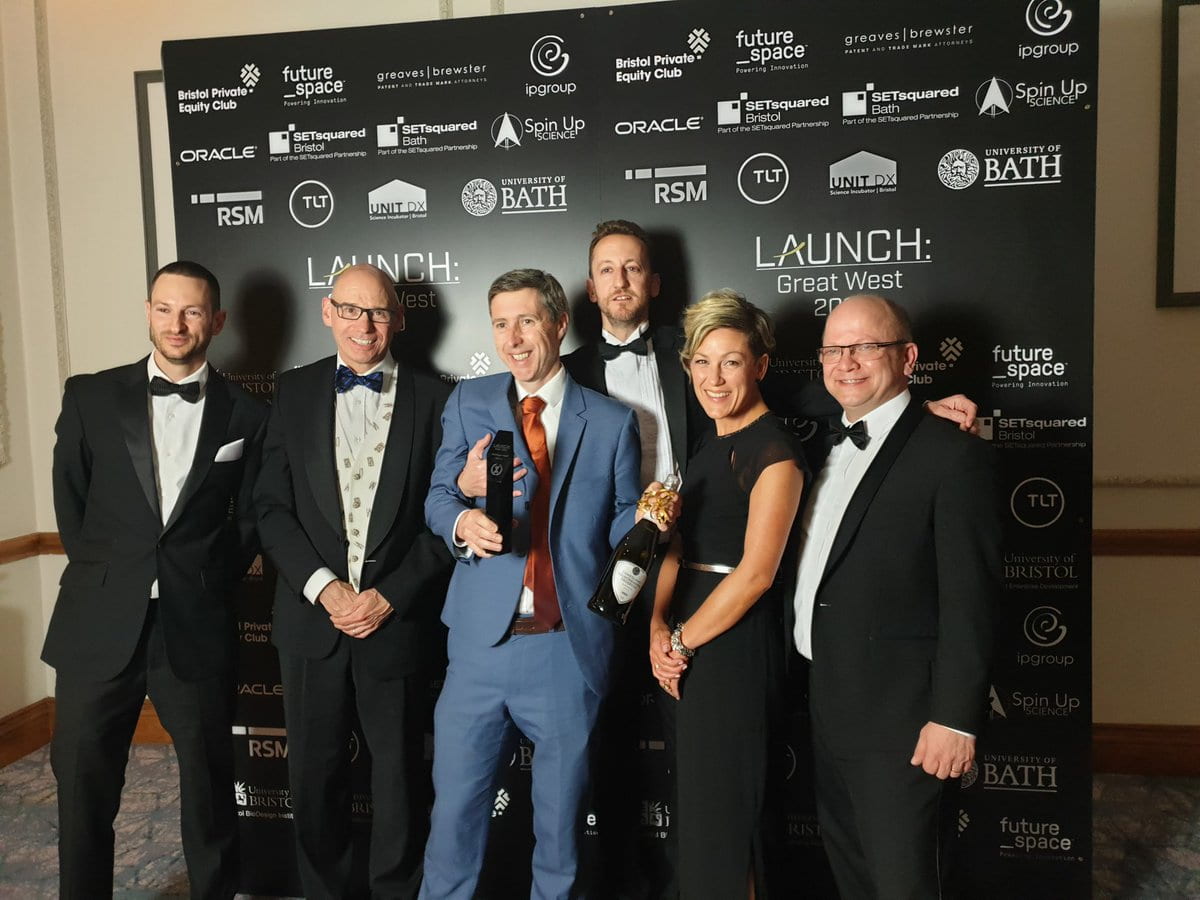
Last night we got dressed up in our best frocks to attend the first Launch: Great West awards. The event aimed to celebrate the growing number of new companies in the SW that leverage the world-class science base of our local universities. It was a buzzing and incredibly professional evening thanks to the hard work of the organisers at Spin Up Science. As a headline sponsor, the Bristol BioDesign Institute was there on mass and we were over the moon to see that companies that use biodesign technologies swept the board, winning five of the eight awards.

The winners were:

The Ones to Watch Award: Rosa Biotech who use biodesign to develop novel sensors inspired by the mammalian olfactory system

The Rising Star Award: CytoSeek who develop new biodesign technologies to enhance cell therapies

The BioDesign Award: Ceryx Medical develop bioelectronics to mimic nerve centres within the body

The Global Good Award: Imophoron use biodesign to develop new types of vaccines to emerging developing-world diseases

The Deal of the Year Award: Ziylo/Carbometrics who took a biodesign approach to the development of new glucose binding molecules leading to a trade sale to Novo Nordisk of up to $800M

This event really shows how far the science entrepreneurship community has grown in the last few years. As our local MP Thangam Debbonaire said in the opening speech, Bristol is growing an amazing innovation ecosystem that builds on the best elements of the University, local industries and city as a whole.

We are very much looking forward to the next event to see if biodesign companies can do even better!

BBI in Berlin: Better together

Max Planck Bristol Centre for Minimal Biology Director Professor Imre Berger, EPSRC SynBio CDT Student Julien Capin, and Bristol BioDesign Institute Scientific Manager Dr Kathleen Sedgley, were invited to present the Max Planck Bristol Centre for Minimal Biology at the British Embassy in Berlin on the 13 and 14 May 2019.

Russel Group Universities’ UK-Europe Knowledge Diplomacy Reception was opened by Chris Skidmore MP, and followed by a panel discussion Chaired by Dr Julie Maxton CBE, Executive Director of the Royal Society.

The UK and Germany work together more than they work with any other country in Horizon 2020, in fact the UK is involved in over half of all German-led EU bids. Between 2013 and 2017 70,000 scientific publications were co-authored between academics in the UK and Germany, 2,177 (3.1%) of which involved the University of Bristol.

Read more about the importance of UK-German collaboration, and the Max Planck Bristol Centre for Minimal Biology (page 11) of the Russell Group Knowledge Diplomacy Reception Brochure.

The second event was organised in collaboration between BUILA (the British Universities International Liaison Association), and their German counterpart DAIA, (the Deutsche Assoziation für Internationalen Bildungsaustausch) supported by the British Council and Universities UK International.

The Max Planck Bristol Centre for Minimal Biology was one of only 10 partnerships selected to to showcase collaborations between the UK, Germany and Europe. Here’s the team with University of Bristol’s Director International, Caroline Baylon.

Read the full ‘Better together’ news item

Bristol launches new Max Planck Bristol Centre for Minimal Biology

Minimal biology is a new emerging field at the interface between the physical and life sciences.  A partnership between the Max Planck-Bristol Centre for Minimal Biology,  the University of Bristol and the Max Planck Society for the Advancement of Science (MPG) in Germany was inaugurated on 27 March 2019.  …. read more